
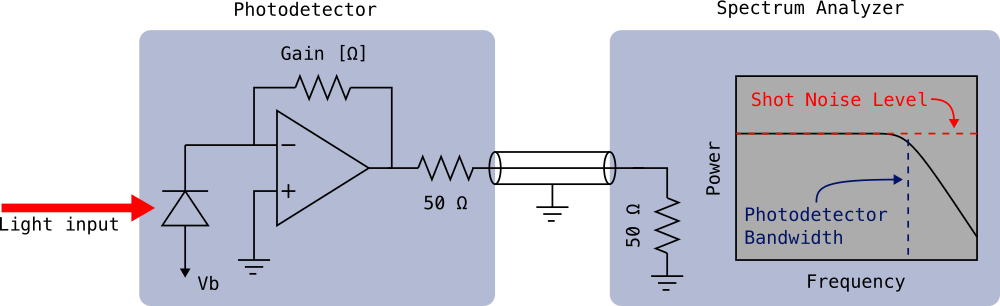
Note: There is a voltage divider formed by the output impedance \(R_\text{out}\) of the TIA and the input impedance \(R_\text{in}\) of the spectrum analyzer, which reduces the signal by a factor \(D = R_\text{in}/(R_\text{out}+R_\text{in})\). Enter the open-circuit transimpedance gain \(Z_\text{TIA}\) (equal to the feedback resistance) along with \(R_\text{out}\) and \(R_\text{in}\); the calculator applies the divider automatically. With the default 50Ω / 50Ω, \(D = 1/2\).
Calculate total input-referred noise including Johnson noise and op-amp noise contributions.
The shot noise level on a spectrum analyzer is calculated using the following formulas:
1. DC Photocurrent:
\[ I_{\text{dc}} = P_{\text{optical}} \times R \]
2. Shot Noise Current Density:
\[ i_n = \sqrt{2eI_{\text{dc}}} \quad \text{[A/}\sqrt{\text{Hz}}\text{]} \]
3. Voltage Divider Factor:
\[ D = \frac{R_{\text{in}}}{R_{\text{out}} + R_{\text{in}}} \]
4. Noise Level on Spectrum Analyzer:
\[ P_{\text{dBm}} = 10 \log_{10}\left(\frac{(i_n \cdot Z_{\text{TIA}} \cdot D)^2 \cdot \text{RBW}}{R_{\text{in}} \times 1\,\text{mW}}\right) \]
where \(e = 1.602 \times 10^{-19}\) C (elementary charge), \(Z_{\text{TIA}}\) is the open-circuit transimpedance gain, RBW is the resolution bandwidth of the spectrum analyzer, \(R_{\text{out}}\) is the TIA output impedance, and \(R_{\text{in}}\) is the spectrum analyzer input impedance. The factor \(D = R_{\text{in}}/(R_{\text{out}}+R_{\text{in}})\) accounts for the voltage divider between them, and \(i_n \cdot Z_{\text{TIA}} \cdot D\) is the noise voltage actually present at the analyzer input.
Responsivity Conversion (Optional): If you don't know your photodiode's responsivity directly but have its quantum efficiency and operating wavelength, you can use the optional calculator above. It converts using:
\[ R = \frac{\eta \lambda}{1240} \quad \text{[A/W]} \]
where \(\eta\) is quantum efficiency (as a fraction, 0-1) and \(\lambda\) is wavelength in nanometers.